Lament from Epirus by Christopher C. King
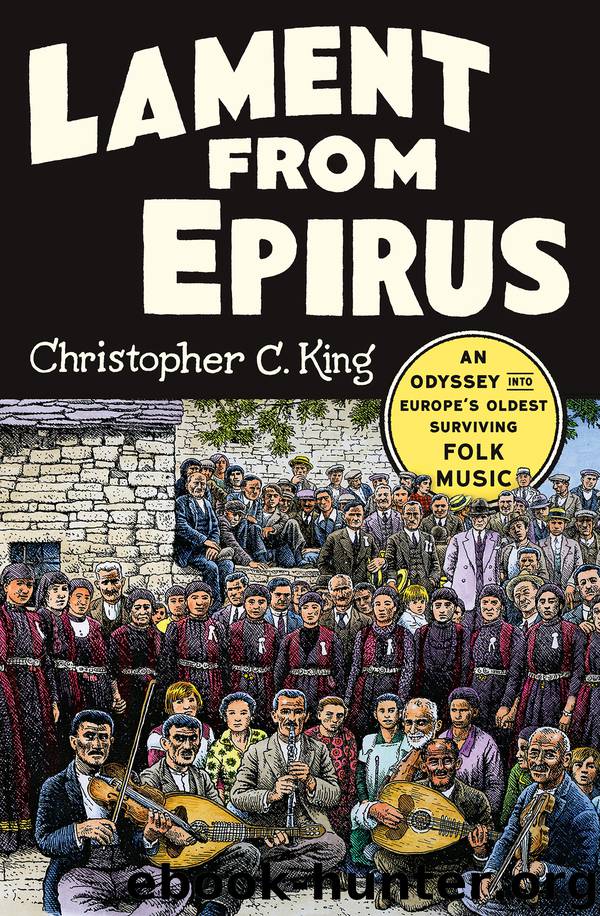
Author:Christopher C. King
Language: eng
Format: epub
Publisher: W. W. Norton & Company
Published: 2018-05-31T04:00:00+00:00
On December 3, 1927, less than one year after Alexis recorded for Victor, Willie Johnson was led into a similar—albeit more improvised—studio in Dallas, Texas. Blind Willie Johnson was a different kind of a man: younger and leaner but just as spiritually expressive as Zoumbas. Just as Zoumbas had the skin of a Roma, Johnson had the skin of a Negro, the child of the first generation of freed slaves. Born in Pendleton, Texas in January of 1897, he was raised within the confines of a region struggling with the devastation of the recent Civil War. In this period, parts of the southern United States were not unlike the environment of Epirus that emerged after World War II and the Greek Civil War. Oppression and violence against the marginalized—sometimes out of sheer spite and jealousy—were cruel, everyday occurrences, part of the life cycle.
Zoumbas had been born with a slight compromise to his vision. According to Johnson’s widow, Willie’s stepmother blinded him when she threw acid in his face after his own mother had died. Little reason was given except that it was done out of spite and jealousy.
When Frank Walker, the executive who supervised regional recordings for Columbia Records, met the blind musician at the makeshift studio in Dallas’s North Lamar Street, he had no idea that this session with Willie Johnson would produce one of the most profound pieces of American folk music ever captured. Likewise, Walker would have been stunned to learn that a recording made by Blind Willie Johnson that day was the spiritual twin of the recording made a year earlier in New York by Zoumbas, itself a lament developed thousands of miles across the Atlantic, countless millennia in our past.
Like Zoumbas, Johnson waited till almost the end of his session to play his masterpiece. With his guitar tuned carefully to open D (D–A–D–F–A–D), Johnson began sliding a glass bottleneck across the strings, playing a piece he called “Dark Was the Night, Cold Was the Ground.” Although the title is based on the first line of a Wesleyan hymn, “Gethsemane,” penned by Thomas Haweis in the nineteenth century, there is very little melodic similarity with the English religious song. Indeed, what Johnson played for exactly three minutes and thirty seconds was a lament barely of this Earth.
Played in the key of D, this piece follows the major pentatonic scale yet moves into the minor pentatonic in the same key. An open note—the low bass D—acts as a dark, tonal center. It floats freely with no beat, no rhythm, no meter. Everything is holding together and falling apart at every instant. Occasional phrases in G pull the scale gently from the major to the minor pentatonic. There are moans and sighs that parallel the guitar phrases, caressing the notes, but there are no coherent vocal phrases: only suggestions of wordless agony.
As the bottleneck wisps along the strings, repeated patterns and motifs, like the sounds of weeping and mourning, emerge from his guitar. A languid vibrato punctuates almost every phrase and the passages themselves are repeated insistently.
Download
This site does not store any files on its server. We only index and link to content provided by other sites. Please contact the content providers to delete copyright contents if any and email us, we'll remove relevant links or contents immediately.
The Universe of Us by Lang Leav(15124)
The Sun and Her Flowers by Rupi Kaur(14566)
Adultolescence by Gabbie Hanna(8962)
Whiskey Words & a Shovel II by r.h. Sin(8050)
Love Her Wild by Atticus(7793)
Smoke & Mirrors by Michael Faudet(6234)
Wiseguy by Nicholas Pileggi(5841)
The Princess Saves Herself in This One by Amanda Lovelace(5003)
Love & Misadventure by Lang Leav(4883)
Memories by Lang Leav(4845)
Milk and Honey by Rupi Kaur(4774)
Bluets by Maggie Nelson(4604)
Too Much and Not the Mood by Durga Chew-Bose(4386)
Pillow Thoughts by Courtney Peppernell(4328)
Good morning to Goodnight by Eleni Kaur(4263)
The Poetry of Pablo Neruda by Pablo Neruda(4167)
Algedonic by r.h. Sin(4092)
HER II by Pierre Alex Jeanty(3639)
Stuff I've Been Feeling Lately by Alicia Cook(3490)
